
Quick Answer
University bursaries are non-repayable cash awards given to students based on household income, personal circumstances, or both. Most UK universities offer them, with amounts ranging from £500 to over £6,000 per year. Many bursaries are assessed automatically through your Student Finance application, which means thousands of students miss out simply because they did not consent to share their income data with their university. You do not need to be exceptional to qualify. You just need to know where to look and what to tick.
Table of Contents
- What Is a University Bursary?
- Bursary vs Scholarship vs Grant: What Is the Difference?
- Who Qualifies for a University Bursary in 2026/27?
- How University Bursaries Work
- How Much Can You Get? Example Bursary Amounts
- NHS Learning Support Fund: Up to £8,000 Per Year
- Bursaries for Care Leavers
- Bursaries for Estranged Students
- Disabled Students’ Allowance
- Educational Charity Trusts and Grants
- How to Find Every Bursary You Are Eligible For
- Common Mistakes That Cost Students Money
- How NZ Associates Can Help (For Free)
- Frequently Asked Questions
What Is a University Bursary?
A university bursary is a cash payment made to students who meet certain eligibility criteria, usually based on household income. Unlike a student loan, a bursary never needs to be repaid. The money is yours to keep and spend on whatever you need, whether that is rent, food, travel, or course materials.
Most UK universities offer bursaries as part of their commitment to widening participation. The idea is straightforward: if your family’s income is below a certain threshold, the university gives you money on top of your student loan to help close the gap between what your maintenance loan covers and what living actually costs.
The amounts vary significantly between institutions. Some offer a few hundred pounds. Others provide several thousand pounds per year for the full duration of your course. The most important thing to understand is that most bursaries are not competitive. If you meet the criteria, you get the money. There is no interview, no essay, and often no separate application.
Bursary vs Scholarship vs Grant: What Is the Difference?
| Type | Based On | Repay? | Application |
|---|---|---|---|
| Bursary | Household income or personal circumstances (means-tested) | No | Usually automatic via Student Finance |
| Scholarship | Academic merit, talent, or achievement | No | Usually requires a separate application |
| Grant | Financial need, specific circumstances, or course type | No | Varies (government grants are assessed via Student Finance) |
| Student Loan | Eligibility for student finance | Yes (once earning above threshold) | Through Student Finance England/Wales/NI/SAAS |
The practical takeaway: bursaries and grants are free money that reduces your real cost of going to university. Scholarships are also free money, but they tend to be more competitive and often require you to demonstrate something specific, whether that is strong grades, sporting ability, or musical talent. All three sit on top of your student loan, meaning they do not reduce the amount you can borrow.
Who Qualifies for a University Bursary in 2026/27?
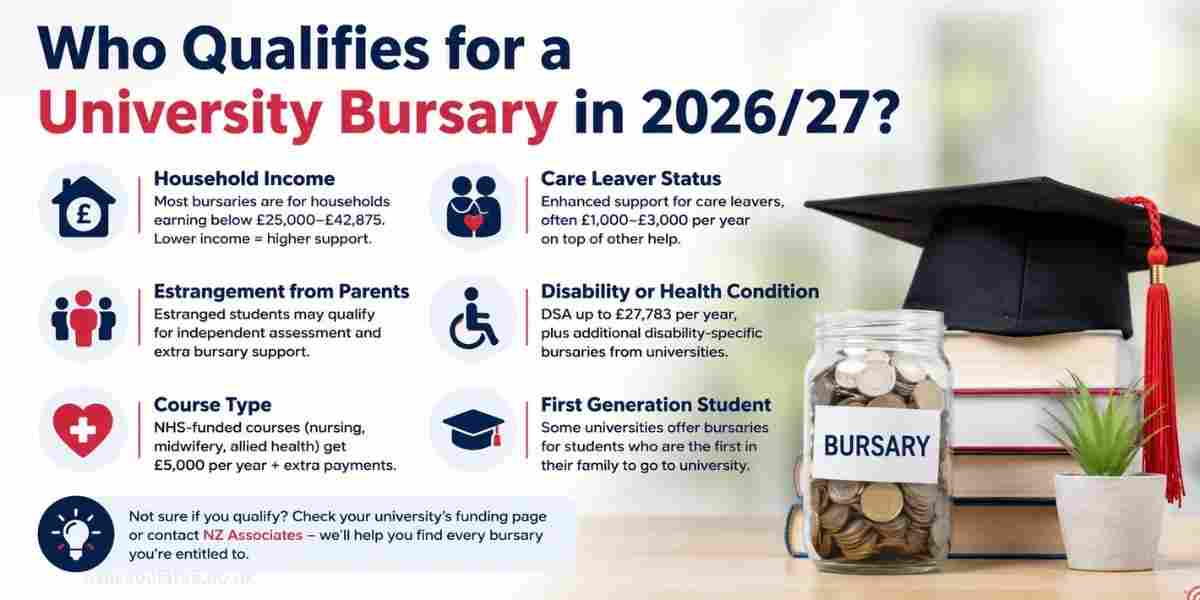 There is no single national eligibility rule for university bursaries. Each institution sets its own criteria, income thresholds, and payment amounts. However, the most common qualifying factors include:
Household income. This is the biggest one. Most university bursaries are available to students from households earning below a certain amount, typically £25,000 to £42,875 depending on the institution. Some universities use tiered systems where lower household incomes attract higher bursary payments.
Care leaver status. If you have spent time in local authority care, you are likely to qualify for enhanced bursary support at most UK universities. Many institutions offer dedicated care leaver bursaries worth £1,000 to £3,000 per year on top of other financial support. Our care leavers’ university guide covers this in detail.
Estrangement from parents. Students who are estranged from their families often qualify for independent assessment and additional bursary support. Read our guide on estranged student finance to understand how this works.
Disability or long-term health condition. The Disabled Students’ Allowance (DSA) provides up to £27,783 per year for eligible students, and many universities offer additional disability-specific bursaries.
Course type. Students on NHS-funded courses such as nursing, midwifery, and allied health professions can access the NHS Learning Support Fund, which provides a non-repayable training grant of £5,000 per year plus additional payments.
First generation in higher education. Some universities offer bursaries specifically for students who are the first in their family to attend university.
If you are unsure whether you qualify, the simplest step is to check your chosen university’s fees and funding page. Better still, speak to our team at NZ Associates and we will help you identify every source of funding you are entitled to.
How University Bursaries Work
The most important thing most students do not realise about bursaries is that many of them are assessed automatically. Here is how the process typically works:
Step 1: You apply for student finance through your regional body (Student Finance England, Student Finance Wales, Student Finance Northern Ireland, or SAAS in Scotland). As part of your student finance application, your household income is assessed.
Step 2: During the application, you are asked whether you consent to sharing your household income data with your university. This is the critical step. If you tick “no” or skip this question, your university cannot assess you for a bursary, even if you would have qualified.
Step 3: If you consent, the Student Loans Company (SLC) shares your assessed household income with your university. The university then checks whether you meet their bursary criteria.
Step 4: If you qualify, the bursary is paid directly into your bank account, typically in two or three instalments spread across the academic year. At some universities, the SLC handles the payment. At others, the university pays you directly.
The key detail: you do not always need to submit a separate application. At many universities, the bursary assessment is completely automatic once your income data is shared. However, some institutions do require an additional form or evidence, so always check your specific university’s process.
Not sure what bursaries you qualify for?
NZ Associates helps students find every penny of funding they are entitled to, completely free. From university bursaries to charity grants, we make sure you do not leave money on the table.
How Much Can You Get? Example Bursary Amounts
Bursary amounts vary widely between universities. To give you a realistic picture of what is available in 2026/27, here are some examples from UK institutions:
| University | Income Threshold | Bursary Amount | Application |
|---|---|---|---|
| University of Oxford (Crankstart) | £32,500 or less | Up to £6,370/year | Automatic via SFE |
| University of Cambridge | £42,875 or less | Up to £3,500/year | Automatic via SFE |
| University of Bradford | Under £40,000 | Variable | Automatic via SLC |
| University of Bristol | £50,000 or less | Tiered amounts | Automatic via SFE |
| Nottingham Trent University | £27,500 or less | £750/year | Automatic |
| University of East Anglia | Means-tested | Variable | Automatic via SFE |
Important: these figures are illustrative. Always verify the exact amounts on your university’s official fees and funding page, as bursary schemes change each year. The point is that real, significant money is available, and in many cases you do not even need to fill out a separate form to get it.
NHS Learning Support Fund: Up to £8,000 Per Year
If you are studying a pre-registration nursing, midwifery, or allied health profession course, the NHS Learning Support Fund (NHS LSF) provides substantial non-repayable funding on top of your student loan. This applies to courses at universities in England, and the fund is not means-tested, meaning your household income does not affect your eligibility.
The funding package for 2026/27 includes a training grant of £5,000 per year, a parental support payment of £2,000 per year for students with dependent children, a specialist subject payment of £1,000 per year for students on courses in areas such as mental health nursing and learning disability nursing, a travel and dual accommodation allowance to cover placement costs, and an exceptional hardship fund of up to £3,000 per year for students experiencing financial difficulty.
For a student on a mental health nursing course who has a dependent child, the total non-repayable support could be £5,000 + £2,000 + £1,000 = £8,000 per year, on top of their full student loan. This is a significant amount of money that many students simply do not know exists.
Applications are made through a digital portal managed by the NHS Business Services Authority (NHSBSA). If you are considering a health and social care degree, this funding makes it far more affordable than many people assume.
Bursaries for Care Leavers
Students who have been in local authority care qualify for some of the most generous bursary packages in UK higher education. Most universities offer a dedicated care leaver bursary worth between £1,000 and £3,000 per year, paid in addition to any income-based bursary you qualify for.
Beyond university-specific bursaries, care leavers are also entitled to a higher rate of maintenance loan from Student Finance England (assessed independently, without parental income), and many local authorities provide their own leaving care grants to help with the transition to university.
The eligibility criteria typically require that you were in local authority care for at least 13 weeks from the age of 14, including time after your 16th birthday. Our comprehensive care leavers’ university guide explains the full range of support available, from bursaries to accommodation guarantees.
Bursaries for Estranged Students
If you are estranged from your parents or family, you face a unique challenge when it comes to student finance: the system assumes your parents will contribute financially, even when they are not part of your life. Estranged students can apply to have their student finance assessed independently, which typically results in a higher maintenance loan.
Many universities also recognise estrangement as a qualifying factor for enhanced bursary support. The Stand Alone Pledge, signed by over 100 UK universities, commits institutions to providing additional financial and pastoral support for estranged students. This can include dedicated bursaries, priority access to hardship funds, and year-round accommodation so you are not left without somewhere to live during holidays.
If you are estranged from your family and unsure what financial support is available to you, our guide on estranged student finance covers every option in plain language.
Disabled Students’ Allowance
The Disabled Students’ Allowance (DSA) is one of the most valuable and most under-claimed forms of student support in the UK. It provides funding for the additional costs you face because of a disability, long-term health condition, mental health condition, or specific learning difficulty such as dyslexia.
For the 2025/26 academic year, the maximum DSA for full-time undergraduates was £27,783 per year as a single allowance. DSA is not means-tested, does not need to be repaid, and does not affect your student loan entitlement. It can cover specialist equipment, assistive software, a note-taker, a mentor, and other support tailored to your needs.
Despite all of this, many eligible students do not apply because they do not realise they qualify or because they find the application process confusing. Our detailed guide on the Disabled Students’ Allowance explains who is eligible, what it covers, and how to apply step by step.
Educational Charity Trusts and Grants
Beyond university bursaries and government support, thousands of UK charities and educational trusts offer small grants to students. These are often overlooked, but they can provide a helpful boost, particularly if you have specific circumstances that align with a trust’s objectives.
The amounts tend to be smaller, typically between £300 and £3,000, and most charities make one-off payments rather than recurring annual awards. However, some students successfully combine grants from several sources to create a meaningful support package.
The best places to search for educational charity grants include Turn2us, a national charity that maintains a searchable database of over 3,000 grant-giving organisations. You enter details about your location, circumstances, and course, and the database returns a list of charities that may be able to help. The Charity Commission register is another useful resource for finding niche educational trusts, particularly local ones that support students from specific geographic areas.
Other notable sources include the Gilchrist Educational Trust, which supports students facing unexpected financial difficulties during their course, and the Sir Richard Stapley Educational Trust, which awards grants of £400 to £1,000 for courses in any subject.
Your university’s student services or money advice team can also point you towards trusts and charities that are particularly relevant to your situation. Many students never ask, which is part of the reason so much of this funding goes unclaimed.
How to Find Every Bursary You Are Eligible For
Finding all the bursaries and grants you qualify for takes a bit of research, but the payoff can be worth thousands of pounds over the course of your degree. Here is a systematic approach:
Check your university’s fees and funding page first. Every UK university publishes details of its bursary schemes on its website. Look for the section specifically for new students starting in 2026/27, as amounts and criteria change from year to year.
Make sure you consent to income sharing on your Student Finance application. This is the single most important step for accessing automatic bursaries. Without your consent, the university cannot assess you, regardless of how low your household income is.
Search the Turn2us grants database. Enter your details and browse the results. Even if each individual grant is small, several together can make a real difference.
Contact your university’s student money advice team. They know about funding sources that may not appear on the main website, including departmental prizes, faculty-specific scholarships, emergency hardship funds, and local trust awards.
Check whether your employer, your parents’ employer, or any professional body you are connected to offers educational grants. Some trade unions, professional associations, and large employers offer bursaries for members’ children or for employees returning to study.
Look into local authority grants. Some councils offer additional support for students from their borough, particularly care leavers and students from disadvantaged backgrounds. If you are studying in London, bursaries from London universities near Stratford and other East London institutions can be particularly generous.
Common Mistakes That Cost Students Money
Having helped thousands of students navigate the funding system, our team at NZ Associates sees the same costly mistakes again and again:
Not consenting to share income data. This is by far the most common reason students miss out on automatic bursaries. When you apply for student finance, there is a question asking whether you consent to your household income being shared with your university. If you say no, or skip it, the university has no way to assess you. Tick yes.
Not applying for student finance at all. Some students from families that intend to self-fund assume there is no point applying for student finance. This is a mistake. Even if you do not want to take out a loan, submitting a student finance application (and requesting zero funding) allows the SLC to assess your household income and share it with your university for bursary purposes.
Assuming bursaries are only for the poorest students. While the largest bursaries do target the lowest-income households, many universities have tiered schemes that extend to household incomes of £40,000, £42,875, or even £50,000. Check before you assume you do not qualify.
Missing the financial assessment deadline. At some universities, bursary assessments must be completed by a specific date (often around July of the academic year). If your parents have not submitted their income evidence on time, you could lose an entire year’s bursary.
Not knowing about DSA. The Disabled Students’ Allowance is not technically a bursary, but it is non-repayable and widely under-claimed. Students with dyslexia, anxiety, depression, chronic fatigue, diabetes, and many other conditions often qualify without realising it.
Not looking beyond your university. Charity trusts, professional bodies, and local authority grants exist outside the university system. They require more effort to find, but the money is real.
How NZ Associates Can Help (For Free)
Navigating bursaries, scholarships, and grants can be confusing, especially when every university has different rules, different deadlines, and different application processes. That is exactly the kind of complexity our team at NZ Associates helps students cut through, and we do it at no cost to you.
As a registered UCAS centre based in Stratford, East London, we offer every service completely free, helping students identify every source of funding they are eligible for, from university bursaries and NHS support to DSA and charity grants. Our support also extends to student finance applications, personal statements, Clearing, and every other part of the university admissions process.
Many paid education consultancies charge hundreds or thousands of pounds for the same guidance we provide at no cost. If you are wondering whether professional support is worth it, our honest comparison of using an education consultant versus applying yourself lays out the differences.
We support students across the UK remotely, and we welcome in-person visits at our Stratford office for students in East London, including those from Newham, Tower Hamlets, Hackney, and Barking and Dagenham.
Find Out Exactly What Funding You Are Entitled To
Our team will review your circumstances and identify every bursary, grant, and allowance you could receive. No fees, no catches, no obligation.
You Might Be Interested In
How to Apply for University With No Money
Practical funding routes for students who think university is financially out of reach.
Disabled Students’ Allowance (DSA) UK 2026
Non-repayable support worth up to £27,783 per year that most eligible students never claim.
Care Leavers’ University Guide UK
Every bursary, grant, and support service available to care-experienced students.
Student Finance Criteria 2026/27
Who qualifies for tuition fee and maintenance loans, and how the assessment works.
Frequently Asked Questions
Do I have to pay back a university bursary?
No. University bursaries are non-repayable. They are cash payments you receive and keep, unlike student loans which are repaid through your salary once you earn above the repayment threshold. The only exception is if you withdraw from your course early, in which case some universities may reclaim a portion of the bursary already paid.
Do I need to apply separately for a bursary?
It depends on the university. Many bursaries are assessed automatically using the household income data shared by the Student Loans Company through your student finance application. Others require a separate application form and supporting evidence. Always check your university’s fees and funding page for the specific process.
Can I get a bursary and a student loan at the same time?
Yes. Bursaries sit on top of your student loan entitlement. Receiving a bursary does not reduce your tuition fee loan or maintenance loan. They are completely separate sources of funding, and you should claim both.
What is the income threshold for university bursaries?
There is no single threshold across all universities. Some target households earning £25,000 or less, while others extend eligibility to £42,875 or even £50,000. Tiered systems are common, where lower-income households receive larger payments. Check the specific criteria for your university.
Can I receive bursaries from more than one source?
In most cases, yes. You can typically receive a university bursary alongside charity grants, the NHS Learning Support Fund (if applicable), and the Disabled Students’ Allowance. However, some universities do not allow their own bursaries to be combined, so check the terms and conditions.
What is the NHS Learning Support Fund?
The NHS Learning Support Fund is a non-repayable training grant of £5,000 per year for eligible students studying pre-registration nursing, midwifery, and allied health profession courses in England. Additional payments are available for students with dependent children (£2,000 per year), specialist subjects (£1,000 per year), travel costs, and hardship (up to £3,000 per year).
How do I find charity grants for university students?
The Turn2us grants database is the best starting point. It contains details of over 3,000 charitable funds. You can also search the Charity Commission register, ask your university’s student money advice team, and check whether professional bodies or employers connected to your family offer educational grants.
What happens if I do not consent to share my income with my university?
If you do not consent to income sharing on your student finance application, your university will not be able to assess your eligibility for automatic bursaries. You may still be able to apply directly, but you could miss out on funding that would otherwise have been awarded without any extra effort on your part.
Are bursaries available for students going through Clearing?
Yes. Students who secure their university place through Clearing are eligible for bursaries on the same terms as any other student. The key is to make sure your student finance application (and income assessment) is submitted as soon as your place is confirmed.
Can mature students get bursaries?
Absolutely. Many university bursaries are available to students of all ages. In addition, mature students are often eligible for additional support such as the Parents’ Learning Allowance, Childcare Grant, and Adult Dependants’ Grant through Student Finance. Some universities also offer bursaries specifically aimed at mature or returning learners.
Written by George Turner, UK Student Finance and University Admissions Specialist with over a decade of experience guiding students through UCAS, SFE, SAAS, SFW, and SFNI applications.
Reviewed by a Senior Student Finance Consultant and UK Higher Education Specialist with hands-on experience in undergraduate and postgraduate admissions.
Last updated: 24 July 2026
Further Reading
- How to Apply for Student Finance England 2026
- UK Student Finance Criteria 2026/27
- Disabled Students’ Allowance (DSA) UK 2026
- Care Leavers University Guide UK
- Estranged Student Finance UK
- How to Apply for University With No Money
- Parents’ Guide to Student Finance 2026/27
- Health and Social Care Degree UK
- Foundation Year UK 2026
- Funded Degrees Near Stratford, London
- Mature Student University UK Guide 2026/27
- A-Level Results Day 2026: What to Do Next
- UCAS Clearing 2026
- Student Finance Deadline 2026
- Education Consultant vs Applying Yourself
- Free UCAS Help in London