
Last updated: 18 July 2026 · Clearing is now open for the 2026 cycle
Results day is coming, and if you’re even slightly worried about not getting the grades you need, this is the guide you want to read before the panic sets in.
Here’s the truth most people don’t tell you: Clearing isn’t a backup plan, a downgrade, or a sign that something’s gone wrong. Over 77,000 students secured a place through Clearing in 2025, making it the busiest Clearing on record. Nearly 17,000 of those were placed on the very first day. Plenty ended up at strong universities, on courses they’re genuinely happy with, including Russell Group institutions.
So whether you’re already nervous about your grades, applying late, or just want a back-up plan ready, this guide explains exactly how UCAS Clearing works in 2026, the dates that matter, and how to give yourself the best shot at a place.
Quick answer: UCAS Clearing 2026 opened on 2 July and runs until 19 October. A-level results day is Thursday 13 August 2026, with results released at 8:00am. Over 77,000 students were placed through Clearing in 2025, including at Russell Group universities. You can browse vacancies now on the UCAS search tool, and Clearing Plus will match you with personalised course suggestions once you’re eligible. NZ Associates offers free Clearing guidance before, during, and after results day.
What’s on this page?
- What Is UCAS Clearing?
- Clearing 2026: Key Dates You Need to Know
- Who Can Use Clearing?
- How Does Clearing Actually Work?
- What Is Clearing Plus?
- Which Universities Offer Clearing Places?
- How to Prepare Before Results Day
- What to Do on Results Day
- How to Make a Clearing Phone Call
- Can International Students Use Clearing?
- Common Clearing Myths
- How NZ Associates Can Help
- Frequently Asked Questions
What Is UCAS Clearing?
Let’s start simple. Clearing is the system UCAS runs to match students who don’t have a university place with universities that still have vacancies on their courses.
Universities list the courses where they’ve still got spaces, and students who need a place apply directly. That’s really all it is, a matching system. Over 77,000 students found their places through Clearing in 2025, and 2026 is expected to be just as busy.
It exists for all sorts of reasons. Maybe your grades didn’t quite hit your firm offer. Maybe you applied late. Maybe you actually did better than expected and want to aim higher. Maybe you simply changed your mind. Whatever the reason, Clearing is a legitimate, well-trodden route, not a last resort.
Clearing 2026: Key Dates You Need to Know
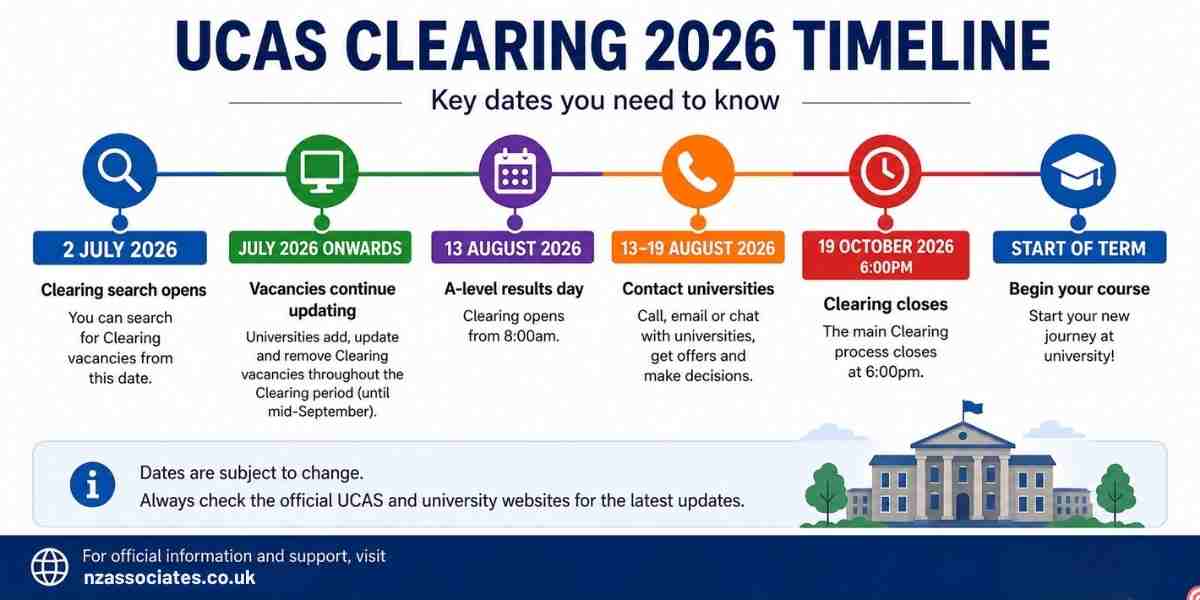 Timing is everything with Clearing, so let’s get the dates straight.
| Date | What Happens |
|---|---|
| 2 July 2026 | Clearing opens. You can start researching vacancies and Clearing Plus begins matching |
| 4 August 2026 | Scottish (SQA) results day |
| 13 August 2026 | A-level results day. The busy phase begins at 8:00am. Clearing choices can be added from 1pm |
| 19 October 2026 | Clearing closes. Final deadline to add a Clearing choice |
For the 2026 cycle, the official Clearing period runs from 2 July to 19 October. Early Clearing opens on 2 July, letting you start applying before A-level results day on 13 August.
But here’s the part that matters most: the genuinely busy window is the 24 to 48 hours after A-level results day. In 2026, that’s Thursday 13 August and the days right after. In 2025, nearly 17,000 students were placed on day one alone, a new record. The better courses fill fast, so the early birds genuinely do better here.
Who Can Use Clearing?
You’re eligible for Clearing if you fall into any of these groups:
- You didn’t receive any offers from your five original UCAS choices
- You declined all the offers you received
- You missed the conditions of both your firm and insurance offers
- You applied after the 30 June deadline (you’re automatically entered into Clearing)
- You did better than expected and want to “self-release” to aim for a higher-ranked university
If you apply after 6pm on 30 June, you’re automatically entered into Clearing. But you can’t actually secure a place until you have your exam results.
New for the 2026 cycle: if you’re applying directly to Clearing after 30 June, UCAS now lets you upload supporting documents (such as a personal statement or reference) through their document upload service. This is optional, but it gives universities more context about you when reviewing your application.
One important note on self-release: UCAS Adjustment no longer exists. It was removed in 2021. What replaced it is self-release, where you decline your confirmed place to aim higher. But this is irreversible. Your original place is gone the moment you decline it. Only do this if you’ve already spoken to your target university and they’ve given you an informal offer.
How Does Clearing Actually Work?
The mechanics are more straightforward than the stress around it suggests.
Once you become eligible, UCAS Hub automatically adds a Clearing button to your account, and the live vacancy list updates throughout the day. You’ll also be given a Clearing number. Keep this handy, because you’ll need it for every call you make.
From there, the process goes like this:
- Browse vacancies in the UCAS search tool. These are live and update in real time
- Call the universities you’re interested in (you have to do this yourself)
- Get verbal permission from the university to add their course
- Add the Clearing choice in your UCAS Hub
- Wait for confirmation from the university, which confirms your place in your application
You can only hold one Clearing choice at a time. Only add a choice once a university has given you permission, and once you add it, it counts as you accepting that offer.
What Is Clearing Plus?
Clearing Plus is a UCAS matching tool that was introduced in 2020, and it sits alongside the standard Clearing process. Instead of you searching for courses manually, Clearing Plus uses an algorithm to match you with courses based on your interests, your grades, and the choices you originally made on your UCAS application.
Once you become eligible for Clearing, a Clearing Plus button appears in your UCAS Hub. When you use it, the system pulls data from your application (your personal statement, your original course choices, your predicted and actual grades) and compares it against live vacancies at universities that have indicated they’d consider students with your profile. You’ll see an initial batch of around 50 matched courses, with more available if you keep browsing.
The matches are personalised, not random. That said, the algorithm isn’t perfect. It sometimes misses good options because of how its matching criteria are set, so it’s worth using Clearing Plus alongside the standard UCAS vacancy search rather than relying on it entirely.
Think of Clearing Plus as a helpful shortlist generator. It can surface courses you hadn’t considered, and it saves time on results day when you’re under pressure. But the standard search tool and direct phone calls to universities are still the core of how Clearing works.
Which Universities Offer Clearing Places?
Most UK universities take part in Clearing, including many Russell Group institutions. In 2025, the UCAS vacancy list included over 30,000 courses across hundreds of universities. That number is expected to be similar for 2026.
However, a small number of highly selective universities almost never have Clearing vacancies. Oxford, Cambridge, Imperial, and LSE rarely (if ever) list courses in Clearing. For almost all other universities, including the rest of the Russell Group, Clearing is a genuine route with real course availability.
One thing worth knowing: the entry requirements shown in Clearing are sometimes lower than the standard offer. Admissions officers have real discretion during this period, and the grade displayed next to a Clearing vacancy may already be below what the course normally asks for. Always check the specific Clearing entry requirement rather than assuming it matches the main cycle offer.
Course availability changes daily during Clearing. New vacancies can appear even after results day as universities reassess their numbers, so keep checking the UCAS search tool regularly.
How to Prepare Before Results Day
This is where you can genuinely get ahead. The students who do well in Clearing aren’t lucky. They’re prepared.
The UCAS Clearing search tool lists vacancies in real time from 2 July, and you don’t need to be in Clearing to browse it. So start now. Build a shortlist of courses and universities you’d be happy with, even if you don’t end up needing them. Once you’re eligible, Clearing Plus will also generate personalised matches, but having your own shortlist ready means you’re not relying on an algorithm alone.
Here’s your pre-results-day checklist:
- Research courses early by browsing the UCAS search tool from July
- Build a shortlist of 5 to 10 realistic back-up options
- Save phone numbers for the universities you’d call
- Have your details ready: UCAS Personal ID, predicted grades, course codes
- Be available on results day morning. Don’t be on a beach with no signal
If you research courses in July and early August, you’ll know exactly which ones to target, turning Clearing from a frantic scramble into a calm, focused process. Read more about what to do on A-level results day?
What to Do on Results Day
 Results day itself moves fast. Here’s the timeline.
At 8:00am, results are released. Check them via your school, the results portal, or UCAS Hub. The Hub will show whether you’ve been confirmed at your firm choice, or whether you’re in Clearing.
If you’re in Clearing:
- Take a breath. This is normal and manageable
- Find your Clearing number in UCAS Hub
- Pull up your shortlist (and check Clearing Plus for personalised matches)
- Start calling early, and always call yourself
Don’t panic-call the first university on your list. Take ten minutes to gather everything you need first. A calm, prepared call beats a frantic one every time.
How to Make a Clearing Phone Call
The phone call is the bit that scares people most, but it’s really just a short, focused conversation.
Clearing calls are short, often five to ten minutes. Admissions teams handle hundreds of calls per hour on results day, so the conversation goes faster if you have your details ready.
Before you dial, have these in front of you:
- Your UCAS Personal ID (the 10-digit number on Hub)
- Your Clearing number
- Your full grades, including every subject
- The course you’re calling about
Clearing calls are essentially mini interviews. The admissions officer is trying to work out whether you’d be a good fit for the course. Expect short, direct questions and prepare brief, honest answers.
One crucial rule: always phone the university yourself. You’re unlikely to be offered a place if you can’t speak for yourself, unless you have a disability that prevents this, of course. And if you can’t get through, try again, or send an email.
If you’re calling about a different subject from your original application, be ready to explain why. Universities can see your original personal statement during Clearing, so a switch in subject will need a quick, honest explanation.
Can International Students Use Clearing?
 Yes, and the process is largely the same.
International students can use Clearing just like UK students. The process is broadly the same, although some universities have additional checks for visa-eligible students. If your route is via a non-UK country, allow extra time for visa processing. In 2025, over 52,000 international students were placed on UK undergraduate courses, the highest number since 2020.
If you’re an international student navigating UK admissions and funding, our guide on whether international students can get student finance is worth reading alongside this.
Common Clearing Myths
Let’s clear up a few things people get wrong.
“Only bad courses are in Clearing.” Not true. In 2025, the UCAS vacancy list included over 30,000 courses. Plenty of strong universities take part, including Russell Group institutions.
“Clearing means you’ve failed.” Completely false. Students use Clearing for all kinds of reasons, including doing better than expected and wanting a higher-ranked place. In 2025, over 5,800 students applied directly into Clearing as their first choice, bypassing the main UCAS cycle entirely.
“It’s too late by results day.” Clearing runs until 19 October, but the best courses do go quickly, so acting early matters.
“You can’t get into a good university.” Tens of thousands of students secure places through Clearing every year, including many who end up at Russell Group universities. The only major exceptions are Oxford and Cambridge, which do not take part in Clearing.
How NZ Associates Can Help
Results day is genuinely stressful, and trying to make big decisions in a panic, with phone lines jammed and the clock ticking, isn’t anyone’s idea of fun. Having someone in your corner who knows the system makes a real difference.
At NZ Associates, we help students navigate Clearing calmly: building a shortlist, preparing for the calls, understanding funding for their new choice, and making sure a last-minute decision is still the right decision. Our guidance is completely free.
If you’re not sure whether you’ll even need university funding sorted in time, our full Student Finance Guide walks through the essentials. If you’re a mature student considering Clearing, our Mature Student University Guide covers everything from funding to applications. And if you missed a deadline along the way, here’s what to do about student finance.
Frequently Asked Questions
When does Clearing open in 2026?
Clearing opens on 2 July 2026 and closes on 19 October 2026. You can browse vacancies from 2 July, but you can’t secure a place until you have your exam results. The busiest period is right after A-level results day on 13 August 2026.
When is A-level results day 2026?
A-level results day is Thursday 13 August 2026. Results are released at 8:00am. Scottish (SQA) results day is earlier, on 4 August 2026.
Do I have to use Clearing if I miss my grades?
Not necessarily. Sometimes your firm or insurance university will still accept you even if you’ve just missed the conditions. Check UCAS Hub first. If both offers are unsuccessful, you’ll automatically become eligible for Clearing.
Can I use Clearing if I got better grades than expected?
Yes, through a process called self-release. You decline your confirmed place to aim for a higher-ranked university. But be careful, this is irreversible, so only do it if your target university has already given you an informal offer.
How many universities can I call in Clearing?
You can call as many as you like. However, you can only hold one Clearing choice in UCAS Hub at a time. If a university doesn’t confirm your place, you can then add another.
Are good universities really available in Clearing?
Yes. Over 30,000 courses appear in Clearing every year, including at Russell Group universities. The only major exceptions are Oxford and Cambridge, which do not take part. The vacancy list updates in real time, so it’s worth checking regularly.
Can international students use Clearing?
Yes. International students can use Clearing the same way UK students do. Some universities have extra checks for visa-eligible students, so allow extra time for visa processing if you’re applying from outside the UK.
What do I need before making a Clearing call?
Have your UCAS Personal ID, your Clearing number, your full grades (including every subject), and the course details ready. Calls are short, often five to ten minutes, so being prepared makes a big difference.
What is Clearing Plus and how does it work?
Clearing Plus is a UCAS matching tool that uses an algorithm to suggest courses based on your grades, interests, and original application choices. It appears as a button in your UCAS Hub once you’re eligible for Clearing. You’ll see an initial batch of around 50 personalised matches, with more available if you keep browsing. It’s best used alongside the standard vacancy search rather than on its own.
Do universities accept lower grades in Clearing?
Sometimes, yes. The entry requirement shown next to a Clearing vacancy may already be lower than the standard offer from earlier in the cycle. Admissions officers have genuine discretion during Clearing, especially on courses with remaining spaces. The only way to know for sure is to call the university directly and tell them your actual grades.
What happens if I don’t find a place through Clearing?
Clearing stays open until 19 October 2026, so you have time beyond results day. New vacancies can appear as universities reassess their numbers. If you still don’t find a place, you have several options: take a gap year and reapply through the standard UCAS cycle for 2027 entry, look into foundation year programmes, or explore degree apprenticeships which combine university study with paid work.
Not sure what to do on results day?
Clearing moves fast, and having someone in your corner who knows the system makes a real difference. Our advisors can help you build a shortlist, prepare for the calls, and make sure your funding is sorted. Completely free.
Written by George Turner, UK Student Finance and University Admissions Specialist with over a decade of experience guiding students through UCAS, SFE, SAAS, SFW, and SFNI applications.
Reviewed by a Senior Student Finance Consultant and UK Higher Education Specialist with hands-on experience in undergraduate and postgraduate admissions.
You might be interested in
UCAS Personal Statement 2026 ›
The personal statement has changed completely for 2026. Learn the 3 new questions and how to answer them.
Student Finance Criteria 2026/27 ›
Got a Clearing place? Check if you qualify for student finance. Full eligibility guide with free expert advice.
Didn’t get the grades for direct entry? A foundation year could be your route in, with no A-levels needed.
Further Reading
- UCAS Personal Statement 2026: How to Answer the 3 New Questions
- UK Student Finance Eligibility Criteria 2026/27
- Foundation Year UK 2026: Do You Need A-Levels?
- Mature Student University UK: Funding and Applications Guide
- Can International Students Get Student Finance?
- How to Apply to University Without Qualifications
- Complete UK Student Finance Guide
- Free Consultation
- UCAS: Clearing and Results Day